Coffee With Noubikko (P1) : How to Enjoy Life With Gen Z
In the third installment of Coffee With Noubikko, the designer reflects on emojis, short attention spans, digital language and the art of integrating with a generation that can edit a video faster than he can order coffee.
 Dante Ulanday - Senior News Editor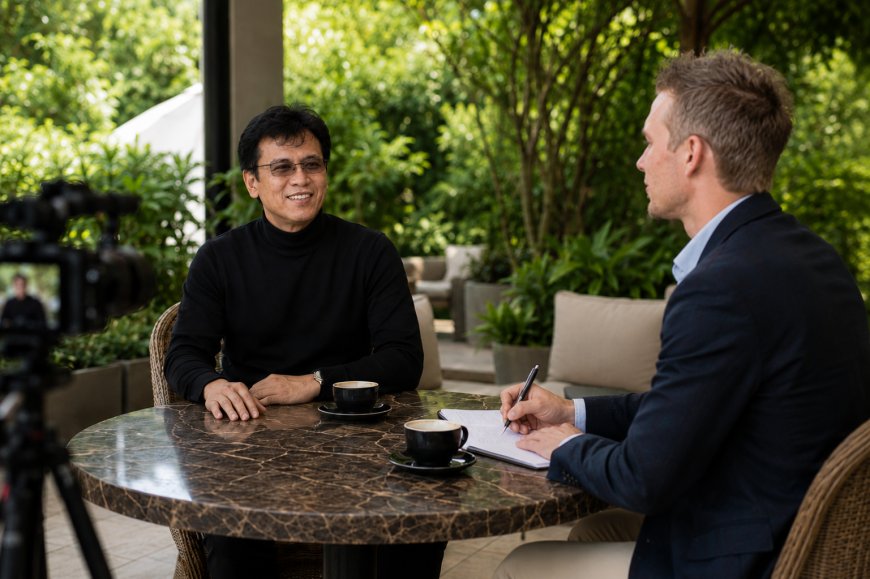
July 6, 2026 - Prague, Czech Republic — Integrating with Generation Z does not require changing your hairstyle, learning the latest dance challenge or pretending to understand every new word that appears on social media, according to designer, and media personality Noubikko.
It does, however, require patience, curiosity and the humility to admit that the meaning of a simple thumbs-up emoji may be more complicated than expected.
“In the past, a thumbs-up meant everything was fine,” Noubikko says. “Now, apparently, it can mean that everything is not fine. I am still investigating.”
In the third installment of Coffee With Noubikko, he discusses what it means to communicate, work and build friendships with Generation Z without trying to become a member of it.
“I am not trying to be Gen Z,” he says. “First of all, I do not have the energy. Second, they would immediately know I was pretending.”
For Noubikko, successful integration begins not with imitation, but with genuine interest.
“You do not connect with younger people by dressing like them, speaking like them or using words you do not fully understand,” he says. “You connect by listening to them.”
Integration Is Not an Audition
Noubikko believes some older people make the mistake of treating communication with younger generations as an audition.
They begin using fashionable expressions, suddenly become enthusiastic about TikTok and insert the word “literally” into conversations where nothing is literal.
“That is not integration,” he says. “That is theatre.”
He believes people should remain comfortable with their own age, experiences and personality while still being willing to understand how younger people communicate.
“Gen Z does not need another Gen Z,” he says. “They already have millions of them.”
What younger people may appreciate, he says, is someone willing to listen without immediately correcting them, lecturing them or beginning every response with the words, “When I was your age.”
“The moment you say, ‘When I was your age,’ everyone knows a long story is coming,” he says. “Some of them begin checking whether their phones still have enough battery.”
For Noubikko, integration is not about erasing generational differences. It is about learning how to work with them.
“The differences are what make the conversation interesting,” he says. “If everybody at the table thinks the same way, it becomes a meeting. I prefer a conversation.”
The Great Communication Adjustment
One of the first things Noubikko noticed about Gen Z is the speed at which they communicate.
“They can send an entire emotional situation using three words, two emojis and a photograph of a cat,” he says. “My generation would have written a four-page letter.”
He admits that learning digital communication has required some adjustment.
A message that says “Okay” may mean okay.
It may also mean disappointment, impatience, anger or the end of a friendship.
“The punctuation is also very important,” Noubikko says. “Apparently, ‘Okay’ and ‘Okay.’ are not always the same emotional experience.”
He has also learned that younger people often prefer voice notes, short videos and direct messages over formal emails.
“I still appreciate a beautifully written email,” he says. “Gen Z sometimes treats email as though it were a telegram delivered by horse.”
However, rather than complain, he tries to understand why younger people favor faster and more visual ways of communicating.
“They grew up receiving information from several directions at once,” he says. “Their communication reflects the world they know.”
Noubikko says older generations should not assume that short communication means shallow thinking.
“A short message can contain a clear idea,” he says. “A long message can also contain absolutely nothing. I have attended meetings that proved this.”
Gen Z Confirms the Noubikko Style: Get to the Point
Working with Gen Z did not teach Noubikko how to be brief. It confirmed that he had been right all along.
He recalls sitting in a meeting while someone delivered a long and carefully prepared explanation of a project. The speaker covered its history, philosophy, inspiration, emotional significance and nearly everything else surrounding it.
A younger colleague listened politely before finally asking:
“So what exactly do you want people to do?”
Noubikko smiled.
“That was the moment Gen Z confirmed the Noubikko style,” he says. “Go directly to the point before everyone forgets why the meeting started.”
For years, he has preferred clear ideas, direct questions and practical answers. He believes sophistication does not require unnecessary complication.
“You can have a brilliant and complex idea and still explain it simply,” he says. “If the explanation lasts longer than the coffee, perhaps the coffee was not the problem.”
The meeting reminded him that clarity is not the enemy of depth. In fact, it often reveals whether the person speaking truly understands the subject.
“Sometimes people add ten minutes of introduction because they are still searching for the point,” he says. “Gen Z simply asks where it is.”
He admires the younger generation’s willingness to interrupt unnecessary ceremony and ask the question everyone else in the room may be thinking.
“They do not always want the history of the building,” he says. “Sometimes they only want to know where the door is.”
Noubikko still values context, thoughtful storytelling and intelligent discussion. But he believes an audience should first understand why they should continue listening.
“You must give people a reason to stay,” he says. “You cannot begin with Chapter One and assume they have already purchased the book, read the introduction and attended the author’s lecture.”
For Noubikko, Gen Z did not change his communication style.
“They simply confirmed it,” he says. “Say what matters, make it clear and finish before someone starts checking their phone.”

What Gen Z Understands Naturally
Noubikko admires how naturally many younger people understand digital platforms, personal branding and visual communication.
“They know that a message is not only what you say,” he says. “It is also how it appears on a screen, how quickly it moves and whether someone will stop scrolling long enough to notice it.”
He sees this as a valuable skill rather than a trivial one.
In the past, media distribution required large organizations, expensive equipment and access to established networks.
Today, a young creator with a phone can reach an international audience from a bedroom, café or train station.
“That is extraordinary,” Noubikko says. “Of course, it also means the bedroom should probably be clean.”
He believes Gen Z understands that identity, creativity and business are increasingly connected.
A person may be a photographer, video editor, entrepreneur, commentator and brand—all at the same time.
“My generation often asked, ‘What is your profession?’” he says. “Gen Z may have six answers before lunch.”
This flexibility has encouraged him to think differently about his own work in fashion, publishing, media and technology.
“They remind me that a person does not always need to fit into one professional box,” he says. “Sometimes the box itself is the problem.”
What Experience Can Offer
Although Noubikko emphasizes how much he learns from younger people, he also believes experience has something valuable to contribute.
Younger generations may understand new tools and platforms, but older generations can offer context, patience and lessons gained from decisions that did not always go according to plan.
“Experience is often a polite word for mistakes we survived,” he says.
He believes older professionals should share those lessons without turning them into sermons.
“Nobody enjoys being treated like a student in every conversation,” he says. “Advice is more useful when it arrives as a story, not a command.”
Instead of telling a younger person what to do, he prefers asking questions.
What are you trying to achieve?
Who are you trying to reach?
What could go wrong?
What happens if the project succeeds?
“The right question can be more useful than a long lecture,” he says. “It also gives the other person room to think.”
Noubikko believes experience becomes more valuable when it helps younger people make their own decisions rather than simply repeat older ones.
“The goal is not to create a younger copy of yourself,” he says. “The goal is to help them become a stronger version of themselves.”
The Language Problem
One of the more entertaining parts of integrating with Gen Z, according to Noubikko, is learning new expressions.
Words that once had one meaning may now have another.
Something can “slap,” although nobody has been touched.
A person may have “main-character energy,” despite the absence of a script.
Someone may say “no cap,” even when nobody was discussing hats.
“I sometimes understand every word individually,” Noubikko says. “The challenge is understanding what they mean when placed together.”
He admits that he does not immediately use every expression he hears.
“There are words that belong naturally to a generation,” he says. “When I use some of them, it sounds less like communication and more like a hostage situation.”
Instead, he asks what the expressions mean and enjoys the explanation.
“Young people are usually happy to teach you,” he says. “They may laugh first, but eventually they explain.”
In return, he sometimes introduces them to expressions from his own time.
“That is when, maybe, they look at me as though I have just presented an artifact from an archaeological site,” he says.
Meetings, Phones and Attention
Noubikko also rejects the assumption that younger people are incapable of paying attention simply because they frequently look at their phones.
“The phone is not always a distraction,” he says. “Sometimes it is the notebook, camera, calendar, research library and editing studio.”
He acknowledges, however, that phones can also become an escape from boring conversations.
“If everybody begins looking at the phone during your presentation,” he says, “there is a possibility that the problem is not the phone.”
Working with younger people has made him more conscious of energy and participation in meetings.
He now prefers conversations where everyone is invited to contribute, rather than meetings dominated by one person speaking for an hour.
“I have learned that a meeting should not feel like a punishment,” he says.
He also appreciates when younger colleagues challenge ideas respectfully.
“They may ask why a decision was made or whether there is a better way,” he says. “That can be uncomfortable, but discomfort is not always disrespect.”
Sometimes, he says, a question reveals that a process exists only because nobody has examined it recently.
“There are systems that continue for years simply because everyone is too polite to ask why,” he says. “Gen Z is often not too polite.”

Mutual Respect Without Pretending
For Noubikko, the key to integration is mutual respect.
Older people should not dismiss younger people as impatient, entitled or inexperienced.
Younger people should not assume that anyone over a certain age is technologically helpless or emotionally attached to a fax machine.
“We all carry stereotypes about one another,” he says. “Then we meet a real person, and the stereotype becomes less useful.”
He believes meaningful integration happens when people stop speaking about generations as if they were opposing political parties.
“Gen Z is not one personality,” he says. “Neither is my generation. Some young people are traditional. Some older people are adventurous. Some people of every age are simply difficult.”
Generational labels can be useful for understanding broad social changes, but they should not replace individual relationships.
“You do not build trust with a demographic,” he says. “You build trust with a person.”
Coffee as Neutral Territory
Noubikko believes coffee provides the ideal setting for intergenerational conversation.
A coffee table has no podium, no formal hierarchy and no requirement that one person pretend to know everything.
“Coffee makes everyone more democratic,” he says. “At least until someone begins discussing which coffee machine is superior.”
Across from a younger person, he asks about technology, music, work, relationships, social expectations and how they imagine the future.
He does not always agree with the answers.
“They do not always agree with mine either,” he says. “That is why it is called a conversation and not a confirmation ceremony.”
He believes disagreement can remain respectful when both people are genuinely curious.
“The objective is not to win,” he says. “The objective is to leave the table understanding something you did not understand before.”
The Best Kind of Integration
Noubikko does not believe integration with Gen Z requires becoming younger.
It requires becoming more open.
“You do not need to wear what they wear, listen to every song they listen to or understand every joke immediately,” he says. “You only need enough curiosity to ask why it matters to them.”
The most successful intergenerational relationships, he says, allow everyone to bring something to the table.
Gen Z brings new tools, new language, new expectations and a willingness to question old systems.
Older generations bring experience, perspective and memories of what happened the last time somebody promised that a new idea would solve everything.
“Together, we may still not know exactly what we are doing,” he says. “But at least we can make better mistakes.”
For Noubikko, integration is not about surrendering one generation’s identity to another.
It is about creating enough room for both.
“I do not need Gen Z to become like me,” he says. “And they certainly do not need me to become like them.”
“What we need is the ability to sit together, share ideas, laugh at our differences and admit that each side knows something the other does not.”
He lifts his coffee cup and smiles.
“And when I do not understand an emoji, I simply ask.”
— Noubikko
About Coffee With Noubikko
Coffee With Noubikko is a conversational interview series exploring Noubikko’s perspectives on fashion, life, business, culture, travel, technology and communication across generations. Each installment invites readers to join an honest, thoughtful and occasionally humorous conversation—preferably over coffee.