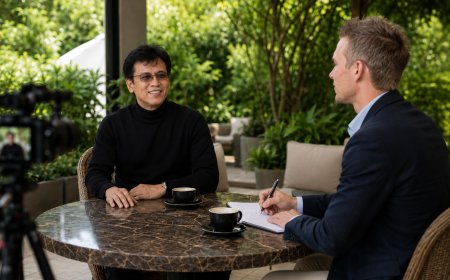
Coffee with Noubikko (P2) - AI Learning Fast Without Starting From Zero
In the latest installment of Coffee With Noubikko, the designer and entrepreneur reflects on artificial intelligence, intergenerational collaboration and why technology should never be reserved only for the young.
 Dante Ulanday - Senior News Editor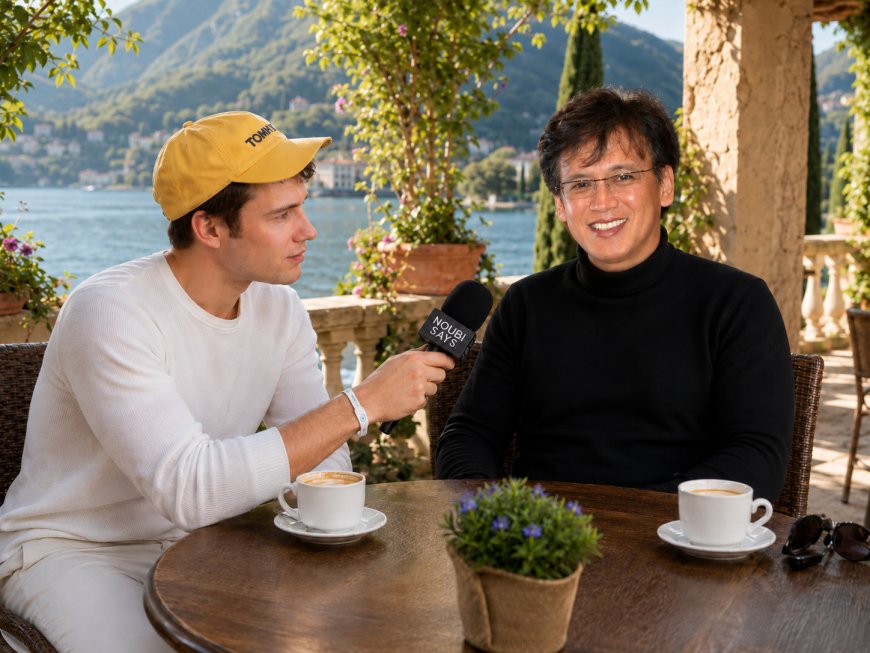
July 5, 2026 — Prague, Czech Republic — Designer and media personality Noubikko is learning artificial intelligence—and, by his own account, he is learning it quickly.
He does not claim to know everything about AI. He also does not believe that being introduced to the technology later in life means he has already fallen behind.
“I may not have grown up with artificial intelligence,” Noubikko says, “but artificial intelligence did not grow up with me either. We are still getting acquainted.”
In the latest installment of Coffee With Noubikko, he reflects on what Generation Z is teaching him about technology, digital communication and the rapidly changing way people create and exchange ideas.
At the same time, he offers a reminder that technology is not designed exclusively for younger people.
“Technology does not belong only to the youth,” he says. “Curiosity has no age limit, and neither does the ability to learn.”
For Noubikko, AI represents not a generational competition, but an opportunity for people of different ages to contribute different strengths.
Generation Z may bring speed, digital fluency and a natural understanding of online communication. Older professionals may bring experience, judgment and a clearer memory of what happened the last time someone promised that a new technology would solve every human problem.
“Together, we may still make mistakes,” he says. “But perhaps we can make more intelligent ones.”
Learning From Generation Z
Noubikko says younger people have helped him better understand how information is now created, consumed and shared.
“They move between video, social media, artificial intelligence and digital platforms very naturally,” he says. “They can record something, edit it, add music and publish it while I am still deciding whether the lighting is flattering.”
He smiles.
“That deserves respect.”
Rather than trying to imitate Generation Z, he prefers to learn directly from them.
“I am not trying to become Gen Z,” he says. “They are not accepting applications, and I am not sure I could survive the interview.”
He believes that meaningful integration between generations begins with curiosity, not performance.
Older people do not need to dress like younger people, adopt every new expression or pretend to understand every social-media trend.
“You do not connect with younger people by copying them,” he says. “You connect by listening to them.”
Noubikko says Gen Z is teaching him how younger audiences think, how quickly they process information and how directly they expect people to communicate.
“They are teaching me to get to the point,” he says. “Sometimes I begin by explaining the history, philosophy and emotional background of a project. Then someone younger asks, ‘What exactly do you want us to do?’”
“That is when I realize I have given them a documentary when they only asked for instructions.”
Technology Is Not a Youth Club
Noubikko rejects the assumption that artificial intelligence should be treated as a private club for younger users.
He notes that many people leading major technology and AI organizations are not members of Generation Z.
“Some of the people running the biggest AI companies are much closer to my generation than to Gen Z,” he says with a smile. “So perhaps I am not really behind.”
He believes people sometimes confuse familiarity with technology with ownership of technology.
“Younger people may learn a new application more quickly because they are accustomed to exploring digital tools,” he says. “But that does not mean older people cannot learn them.”
The key, he says, is being willing to ask questions without embarrassment.
“There is great freedom in saying, ‘I do not know how this works. Show me,’” he says. “You learn much faster when you are not busy protecting your reputation.”
Noubikko approaches artificial intelligence with the same curiosity that has guided him through more than four decades in fashion, media, restaurants, marketing and entrepreneurship.
“I am learning AI, and I am learning fast,” he says. “But I am not starting from zero.”
He is bringing decades of professional experience into a new technological environment.
“That experience does not disappear simply because a new application appears,” he says. “It comes with me.”
Forty Years of Business Cannot Be Downloaded Overnight
Noubikko recognizes that AI can process information, identify patterns, organize documents and develop ideas at extraordinary speed.
However, he believes technology cannot instantly reproduce judgment built through decades of dealing with people, businesses, negotiations, successes and mistakes.
“AI can provide information,” he says. “Experience often tells you what the information does not say.”
More than 40 years in business have taught him to observe people closely, recognize motives and notice when words and behavior do not match.
“I do not need AI to make a prompt asking who in the room is pretending,” he says. “Usually, I already know before the coffee is served.”
He laughs, then adds that human instinct is not always perfect.
“Of course, occasionally the person pretending is me,” he says. “That is why humility is also useful.”
For Noubikko, artificial intelligence and experience should not be treated as rivals.
“AI gives me speed,” he says. “Experience gives me judgment.”
“One can tell me what the data suggests. The other can sometimes tell me why someone is presenting the data in the first place.”
He sees AI as a powerful assistant, but not as an unquestionable authority.
“I treat artificial intelligence as a very fast assistant,” he says. “A brilliant assistant, perhaps—but one that still needs supervision.”
Integration Is Not Imitation
Noubikko believes some older people become uncomfortable around younger generations because they assume integration requires them to act younger.
He disagrees.
“Gen Z does not need another Gen Z,” he says. “They already have millions of them.”
What they may appreciate, he believes, is someone who is interested in their ideas without immediately correcting them or turning every conversation into a lecture.
“The moment you begin with, ‘When I was your age,’ everyone knows a long story is coming,” he says. “Some of them quietly check the battery on their phones.”
He prefers an exchange in which both generations contribute.
“They show me what is changing,” he says. “Perhaps I can help explain what came before, what worked, what failed and what should not be repeated.”
He emphasizes that learning from younger people does not diminish the value of experience.
“Listening to Gen Z does not mean surrendering everything you know,” he says. “It means allowing new information to enter the room.”
He believes the strongest relationships across generations happen when neither side is trying to prove superiority.
“Young people should not assume that everyone older is technologically helpless,” he says. “Older people should not assume that every young person lacks discipline or patience.”
“Sometimes the person with the most useful idea is simply the person who has been given the least opportunity to speak.”
The Great Communication Adjustment
One of the biggest adjustments for Noubikko has been learning how younger people communicate.
“They can explain an entire emotional crisis using three words, two emojis and a photograph of a cat,” he says. “My generation would have written a four-page letter.”
He has also discovered that punctuation can carry emotional meaning.
“Apparently, ‘Okay’ and ‘Okay.’ are not always the same,” he says. “The period may contain an entire argument.”
New expressions can also require translation.
Something can “slap,” although nobody has been touched.
Someone can have “main-character energy,” despite the absence of a film crew.
A person may say “no cap,” even when hats are not being discussed.
“I sometimes understand every word individually,” Noubikko says. “The challenge is understanding what they mean when placed together.”
He does not immediately use every new expression he hears.
“There are words that belong naturally to a generation,” he says. “When I use some of them, it sounds less like communication and more like a hostage negotiation.”
Instead, he asks younger people to explain what the expressions mean.
“They usually laugh first,” he says. “Then they teach me.”
What Experience Can Offer Gen Z
Although Noubikko emphasizes how much he is learning from Generation Z, he also believes experience can offer something important in return.
Years in business can teach patience, timing, negotiation and the ability to recognize consequences that may not be immediately visible.
“Experience is often a polite word for mistakes that did not destroy us,” he says.
He believes older professionals should share those lessons without turning them into commands.
“Advice is easier to accept when it arrives as a story rather than a sermon,” he says.
Instead of immediately telling younger people what they should do, Noubikko prefers to ask questions.
What are they trying to achieve?
Who are they trying to reach?
What could go wrong?
What happens if the idea succeeds?
“A good question can be more valuable than a long lecture,” he says. “It gives the other person space to think.”
The purpose of experience, he believes, is not to create younger copies of older professionals.
“The goal is not to make them become like us,” he says. “The goal is to help them become better versions of themselves.”

AI as a Creative Partner
Noubikko now uses artificial intelligence to explore ideas, organize information, preserve stories and create content for different platforms and audiences.
He is particularly interested in how one idea can be developed into an article, video, interview, social-media post or documentary concept.
“Artificial intelligence does not replace curiosity,” he says. “It gives curiosity more tools.”
He also uses AI to understand how younger audiences consume information.
“I may begin with a long article,” he says. “Then someone from Gen Z reminds me that I have approximately seven seconds to capture attention.”
He pauses.
“That is pressure.”
For Noubikko, AI is most useful when it supports human creativity rather than attempting to replace it.
“It can produce something quickly,” he says. “But quickly does not always mean wisely, beautifully or truthfully.”
Human judgment, he believes, must remain involved.
“The machine can generate possibilities,” he says. “The person must still decide which possibility deserves to exist.”
Teaching AI the Meaning of Kindness
Noubikko believes the rise of artificial intelligence also brings a human responsibility.
AI may learn language, but it does not experience compassion in the same way people do.
“It does not sit beside someone in a hospital,” he says. “It does not miss a friend. It does not know what it feels like to forgive or to be forgiven.”
However, he believes people can teach technology the language and principles of kindness through the way they use it.
“We teach AI through the questions we ask, the words we choose and the values we bring into every conversation,” he says.
The quality of AI, he argues, will partly reflect the intentions of the people using it.
“Technology may provide intelligence,” he says, “but human beings must provide the humanity.”
That responsibility does not belong only to engineers or technology companies.
It also belongs to everyday users.
“Technology should never replace kindness,” he says. “It should help us communicate kindness more clearly and share it more widely.”
Noubikko believes technological progress means very little if human behavior becomes less thoughtful in the process.
“We can build very intelligent machines,” he says. “But if we become less honest, less patient and less compassionate, then perhaps we misunderstood the assignment.”
Coffee as Neutral Territory
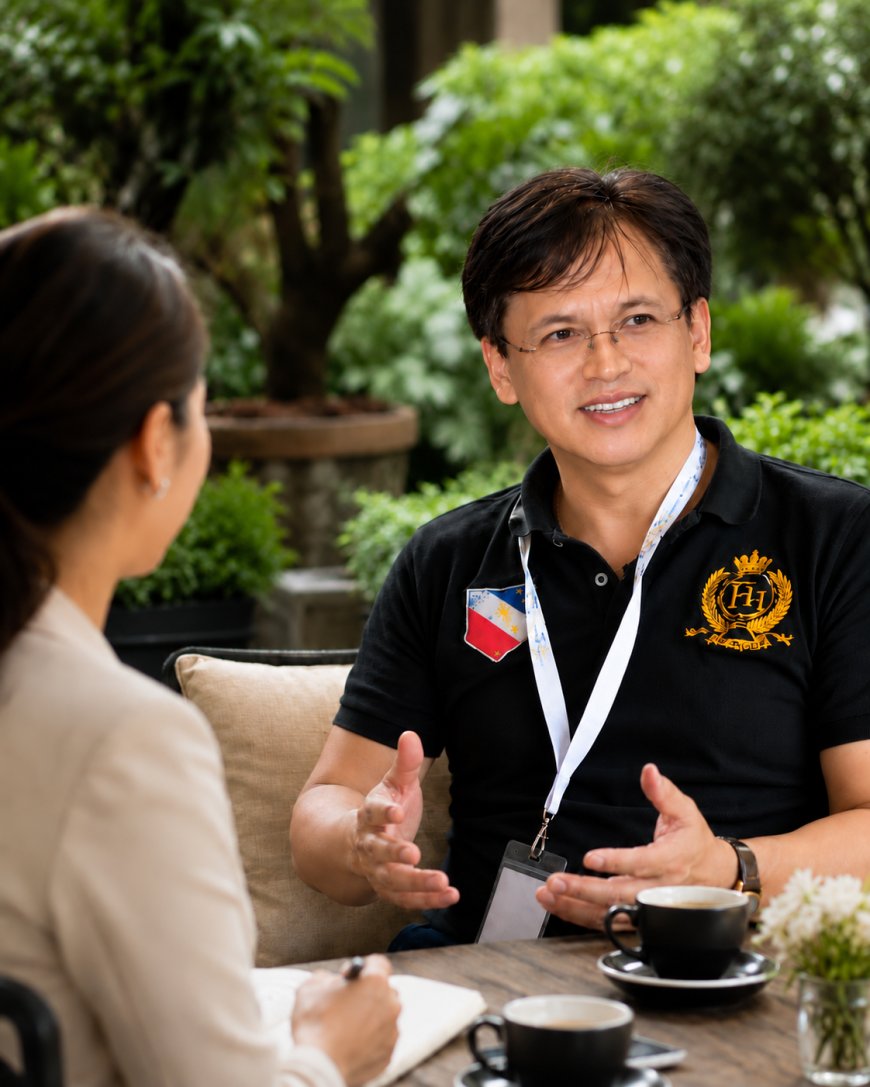
For Noubikko, coffee remains the ideal setting for conversations between generations.
A coffee table has no podium and no formal hierarchy.
“Coffee makes everyone more democratic,” he says. “At least until someone begins explaining why their coffee machine is superior.”
Across the table from younger people, he asks about technology, music, work, relationships, expectations and how they imagine the future.
He does not always agree with their answers.
“They do not always agree with mine either,” he says. “That is why it is called a conversation and not a confirmation ceremony.”
He believes disagreement can remain respectful when both sides are genuinely curious.
“The objective is not to win,” he says. “The objective is to leave the table understanding something you did not understand when you arrived.”
Arriving With Luggage
Noubikko does not believe integrating with Gen Z requires becoming younger.
It requires becoming more open.
“You do not need to wear what they wear, listen to every song they listen to or understand every joke immediately,” he says. “You need enough curiosity to ask why it matters to them.”
He believes younger and older generations should not be placed on opposite sides of the future.
“They belong at the same table,” he says. “Youth brings energy, speed and new possibilities. Experience brings context, patience and memory.”
Noubikko says he is not learning artificial intelligence to prove that he can still participate in the modern world.
He is learning because he remains curious about what the modern world can become.
“I do not consider myself behind,” he says. “I am simply arriving with luggage.”
Inside that luggage are more than 40 years of business experience, lessons from different industries, memories of successes and failures, and an instinct for understanding people that no software update can immediately install.
“Gen Z is teaching me new ways to create and communicate,” he says. “AI is helping me explore new possibilities. Experience reminds me which possibilities deserve my attention.”
He lifts his coffee cup and smiles.
“And when I do not understand the technology, I ask.”
“When I do not understand the person, I listen.”
“And when someone in the room is pretending, usually, I already know.”
— Noubikko
About Coffee With Noubikko
Coffee With Noubikko is a conversational interview series exploring Noubikko’s perspectives on life, fashion, entrepreneurship, and culture across generations. Each installment brings different ideas, experiences and generations together in an honest and occasionally humorous conversation—preferably over coffee.